
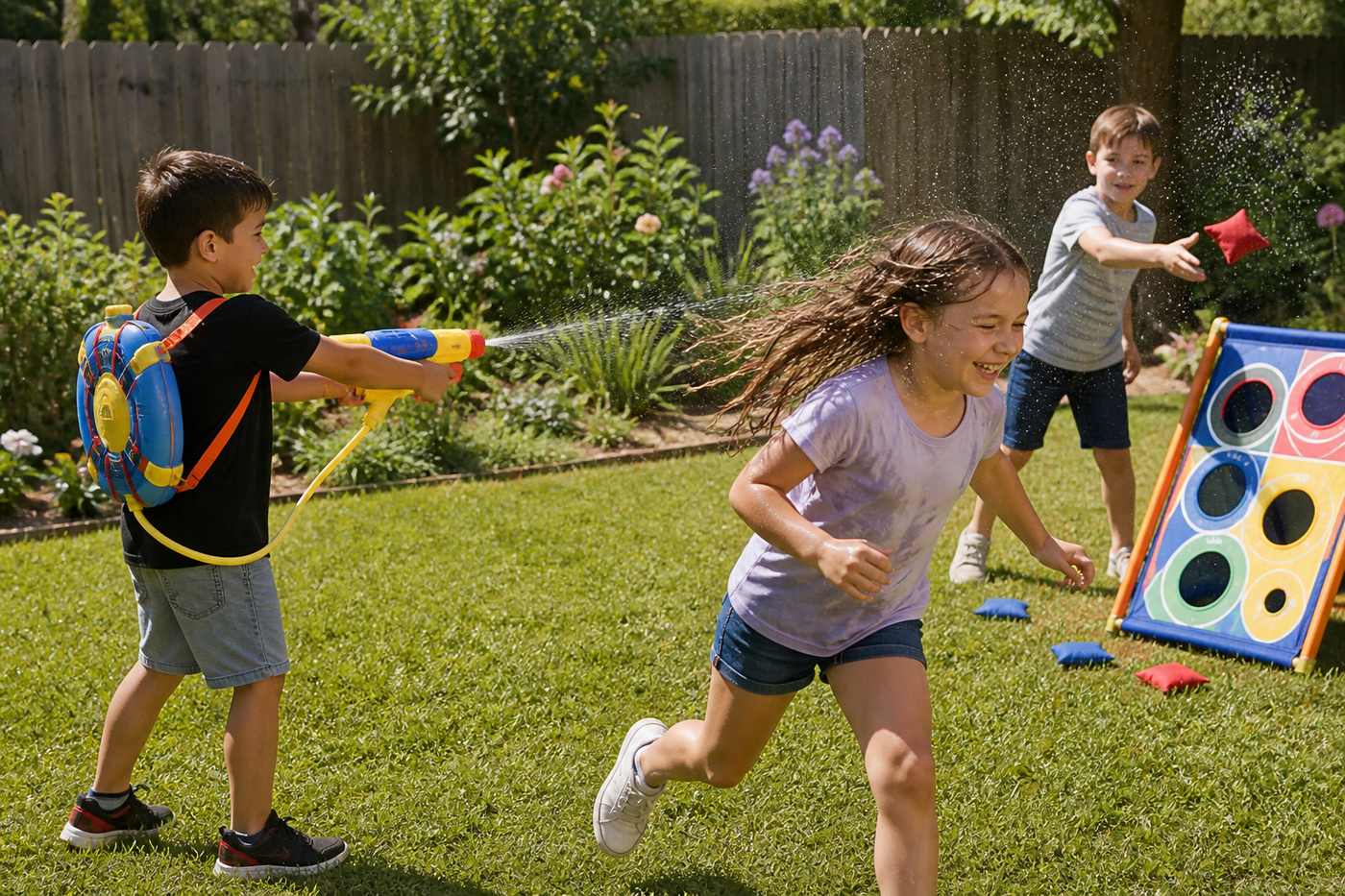
Backyard games wholesale assortment fit is decided by three things you can verify before you commit: outdoor failure mode (UV fade, chlorine, drop impact), a material callout that matches the use case, and a supplier who will answer process questions in writing. A low FOB price tells you almost nothing about whether a backyard game belongs in your program. Two suppliers can quote the same cornhole set, and only one of them can tell you the masterbatch grade behind the board colour and the wall thickness at the hinge boss.
This guide is built for outdoor toy distributors, sporting-goods retailers, camp buyers, resorts, and ecommerce teams who need a defensible decision, not a toy ranking. You will get a use-case-to-material-to-test map, a shortlist of comparable product records you can use as RFQ anchors, and the exact questions that separate a factory that has shipped outdoor goods for years from one that has only shipped to a warehouse.
The Short Version for Buyers
- Stock backyard games by failure mode, not by category name. A water gun, a cornhole board, and a light-up soccer goal fail differently, so they need different material specs and different test requests.
- Ask for the masterbatch or colourant grade, not just "UV resistant". Fade under direct sun is a colourant and stabiliser question, and a factory that cannot name the grade cannot control the second lot.
- Match MOQ to storage and reorder velocity, not to the lowest unit price. A mixed container only works if the filler SKU actually turns; slow premium wood sets tie up cash and shelf space.
- Get the inspection plan on the PO. Defect classification (critical, major, minor) belongs in the quality agreement, not in a catalogue sentence or a verbal promise.
- Confirm the destination market before you pick compliance evidence. Great Britain and Northern Ireland use different product-marking routes for toys, and that changes which documents you request.
Comparable Backyard Games Records: RFQ Anchors
| Portable bean bag cornhole toss set with 8 bean bags | Price posture | Material | Age/Use | Best for | Rating | MOQ 36, 5.00 USD/unit | Material not declared on record — confirm board and bag fabric | Family backyard toss, garden centre display | Garden centres and family retail entry tier | Rating: not supplied in the source record |
|---|---|
| 3-in-1 dinosaur basketball, soccer and bean bag toss set | Price posture | Material | Age/Use | Best for | Rating | MOQ 72, 5.40 USD/unit | Plastic | Kids outdoor summer play | Seasonal summer displays and camp programmes | Rating: not supplied in the source record |
| Adjustable kids basketball hoop with ball | Price posture | Material | Age/Use | Best for | Rating | MOQ 36, 5.64 USD/unit | Plastic | Indoor/outdoor toss play, boys and girls | Sporting-goods retailers and ecommerce | Rating: not supplied in the source record |
| Light-up soccer goal set | Price posture | Material | Age/Use | Best for | Rating | MOQ 54, 4.90 USD/unit | Plastic | Outdoor/indoor sport play | Ecommerce and family retail | Rating: not supplied in the source record |
| Automatic electric water blaster, soft bullet, AK/M416/MP5 form | Price posture | Material | Age/Use | Best for | Rating | MOQ 48, 4.00 USD/unit | ABS | Outdoor shooting game, water and foam | Summer outdoor battle programmes | Rating: not supplied in the source record |
| Electric soft bullet gun with automatic water blaster function | Price posture | Material | Age/Use | Best for | Rating | MOQ 72, 6.64 USD/unit | Plastic | Outdoor battle games | Distributors running battle-game sets | Rating: not supplied in the source record |
| SKD electric luminous gun, soft bullet | Price posture | Material | Age/Use | Best for | Rating | MOQ 12, 9.67 USD/unit | Plastic | Outdoor battle games, luminous play | Buyers testing a premium battle SKU at low MOQ | Rating: not supplied in the source record |
| AI smart target shooting set with electronic voice scoring | Price posture | Material | Age/Use | Best for | Rating | MOQ 30, 19.06 USD/unit | Plastic | Target shooting with digital scoring | Resorts and premium ecommerce tiers | Rating: not supplied in the source record |
| Electronic digital scoring target set with soft bullet | Price posture | Material | Age/Use | Best for | Rating | MOQ 120, 5.55 USD/unit | Plastic | Target practice, group play | Camp buyers and event programmes | Rating: not supplied in the source record |
| Light-up bow and arrow set with target and suction-cup arrows | Price posture | Material | Age/Use | Best for | Rating | MOQ 240, varies by spec | Plastic | Outdoor sport play, boys and girls | High-volume seasonal promotions | Rating: not supplied in the source record |
| Rechargeable kids walkie talkie pair with flashlight | Price posture | Material | Age/Use | Best for | Rating | MOQ 360, 5.55 USD/unit | ABS | Outdoor game interphone play | Camp and resort group programmes | Rating: not supplied in the source record |
| RC shark and stingray for pool play | Price posture | Material | Age/Use | Best for | Rating | MOQ 126, 7.41 USD/unit | Plastic | Pool and water play | Resort and pool-side retail | Rating: not supplied in the source record |
Which outdoor failure mode should decide the material you ask for?
Ask for the material that survives the specific failure mode of the use case, not the material that sounds premium. A light-up soccer goal left in a yard for a full summer fails on UV fade and impact cracking; a cornhole board in a garden centre window fails on sun fade and moisture warping; a water blaster fails on seal fatigue and chlorine exposure after pool play. Each failure mode points to a different question for the factory.
For moulded plastic outdoor games, the questions that matter are the polymer or blend, the wall thickness at stress points such as hinge bosses and handle roots, and the colourant or masterbatch grade. HDPE is generally stiffer than LDPE and is used for rigid or semi-rigid moulded and blow-moulded parts when its chemical and impact balance fits the design — useful when you need a board or base that holds shape. ABS appears on records for water blasters and walkie talkies; it gives a harder shell but needs a UV package if it will sit in the sun. Where the record shows only "Plastic", treat the grade as unknown and make it an RFQ line item.
For wood sets, species and finish decide the outdoor life. Hardwoods are more durable than softwoods in repeated outdoor play, and a factory that will name the species and the coating is easier to audit than one that says "solid wood". For inflatables and soft goods, puncture-resistant PVC or TPU and seam construction matter more than colour.
Treat all of it as a specification you can write into the PO and then verify against a sealed physical sample — colour, fit, flash, and function — rather than a photo.
Use case | material to ask for | test to request
Use this map to convert a buyer scenario into a concrete RFQ line. The test column is what to request for your destination market; the applicable standard or test scope depends on the product, the age grading, and the market, so confirm it with the factory and your lab rather than assuming.
| Backyard toss and cornhole (family retail, garden centres) | Material to ask: board substrate and coating, bag fabric and fill. Test to request: UV/colour-fastness evidence and a moisture/outdoor-use claim in writing; confirm destination-market toy or sporting-goods scope before ordering. |
|---|---|
| Water and pool games (resorts, pool-side retail) | Material to ask: ABS or plastic shell grade, seal material, colourant grade for chlorine and sun exposure. Test to request: seal/leak function test protocol and colour-fastness evidence; confirm the age grading on the record. |
| Battle and target shooting games (distributors, camps) | Material to ask: ABS or plastic shell, projectile material and hardness, luminous or electronic component spec. Test to request: impact/drop test protocol and function test on the electronic module; confirm battery and electronics documentation for the destination. |
| Light-up and electronic sport games (ecommerce, family retail) | Material to ask: plastic housing grade, LED module and switch rating, battery compartment construction. Test to request: function and drop test protocol, plus battery safety documentation for the destination market. |
| Wood yard games (premium and gift tiers) | Material to ask: species, moisture content, coating type, carry-case material. Test to request: stability and finish durability evidence; confirm the wood and finish claims in writing before you print them. |
| Inflatable and soft yard games (events, resorts) | Material to ask: PVC or TPU grade, seam construction, valve type. Test to request: puncture and seam integrity protocol, plus inflation/pressure instructions; confirm commercial-use suitability in writing. |
Where are backyard games usually produced?
Backyard games are produced in different Chinese clusters depending on the material, and knowing the cluster tells you which process questions to ask. Injection-moulded plastic games concentrate in Chenghai, Shantou — the cluster that supplies most plastic outdoor and battle-game SKUs. Wooden yard games and wooden components concentrate in Yunhe, Zhejiang. Plush and soft goods sit in Yangzhou, Jiangsu. General merchandise, mixed sets, and accessory-heavy bundles are typically sourced through Yiwu, Zhejiang.
This matters because the failure modes differ by cluster. Chenghai plastic suppliers will talk wall thickness, mould ownership, and masterbatch; Yunhe wood suppliers will talk species, moisture content, and coating; Yiwu traders will often quote a finished set without owning the mould or the wood line. None of that makes one cluster better — it tells you which evidence to demand.
Avoid the trap of asking a trading company for a mould-level answer it cannot give, and avoid assuming a factory-direct price from a cluster you have not audited. Ask who owns the tooling, where the parts are moulded or cut, and which entity signs the inspection plan.
What MOQ should I expect, and how does it change assortment fit?
MOQ varies widely by SKU type and by whether the factory owns the tooling, so treat any single number as a starting point for negotiation rather than a market rate. In the comparable records used here, MOQs range from 12 units on an SKD electric luminous gun to 360 units on a rechargeable walkie talkie pair, with most plastic outdoor games sitting between roughly 30 and 240 units. Wood and inflatable categories typically carry their own order logic and should be quoted separately.
The assortment decision is not "which SKU has the lowest MOQ". It is whether the order quantity you can commit matches the storage you have and the velocity you expect. A buyer filling a mixed container alongside outdoor goods often uses a fast-turning mid-price game as filler — the category that fits small space and moves quickly — while keeping one or two higher-ticket premium SKUs for display and margin. If a premium SKU cannot turn before the next season, it is inventory, not assortment.
Ask the factory for the MOQ at the colour, packaging, and branding configuration you actually want. MOQ usually moves when you add custom colour, private label, or a new mould, and that change is where the real cost sits.
What supplier evidence should I collect before committing to a season?
Collect a sealed physical sample, a written inspection plan, and a colour or material reference — three things that survive staff turnover and lot-to-lot drift. A photo approval is not evidence. In Chenghai, the argument that ends a colour dispute is the sealed golden sample on the QC shelf: bulk is compared to that physical piece for colour, fit, flash, and function. Buyers who approve only a photo pay for it on the second lot.
Put defect classification in the quality agreement. Critical, major, and minor defects should be defined by the buyer and the factory together rather than left to informal factory language. If you want an AQL number, get it from the agreed inspection plan on the PO, not from a catalogue sentence. A factory that will not commit to an inspection plan in writing is telling you something.
Ask how a failed lot is handled: is it isolated, is the defect class recorded, and is release conditional on rework? That process question reveals more than a sample ever will.
Incoterms define when risk transfers between seller and buyer; they do not define product-safety compliance or who owns the test reports. Decide those separately in the contract, and name the entity that holds the report.
Which certification evidence applies to backyard games in the US and EU?
The evidence you request depends on the destination market and the age grading, and it should be confirmed against current official sources before you commit. For the United States, toy-scope products are commonly assessed against ASTM F963 and Outdoor Toy requirements covering lead content and phthalates; for the EU, EN 71 and REACH are the familiar references. Test reports from accredited labs are the documents buyers typically request.
The destination detail that trips people up is the UK. Great Britain and Northern Ireland use different product-marking routes for toys, so the listing must identify the destination before you select CE, UKCA, or CE UKNI evidence. A single "UK compliant" statement is not enough.
Backyard games are not automatically in toy scope. Some SKUs — sporting goods, pool accessories, electronic modules — may sit under a different regime or carry additional requirements. Make the classification a written RFQ question, and never let a supplier's marketing page stand in for the applicable standard.
How do I judge assortment fit across channels?
Fit is channel-specific, and the same SKU can be right for a camp and wrong for a garden centre. Work through the channel's storage, season length, and customer age mix before you look at price.
Sporting-goods retailers and ecommerce teams need breadth and reorder velocity: entry-price plastic games that ship flat and restock fast, plus a small premium tier for margin and gifting. Garden centres need display-friendly sets that survive a window or outdoor bench — sun fade and moisture are the enemies, so the material callout matters more than the novelty. Camp and resort buyers need group-play durability and quantity; electronic scoring and rechargeable items are attractive but add battery and after-sales load, so test the module and confirm the documentation before you scale. Family retail and seasonal display programmes usually win with a tiered mix: one low-cost impulse game, one mid-price hero SKU, and one premium wood or electronic set that anchors the display.
The next action is the same for every channel: take three to five comparable records, request the material grade, the inspection plan, and the compliance route for your destination, then order a sealed sample and compare the production lot against it. If a supplier cannot answer the material and inspection questions in writing, the assortment fit question is already answered.
How we picked these records
The records in the comparison table are drawn from approved product records with stated MOQ, material, and price where available; missing fields are marked rather than filled. They are used as RFQ anchors, not as a ranking, and no supplier is named as a winner. No customer review or rating data was available for this article, so none is quoted.
The selection criteria were: outdoor-use relevance, a stated material or a clear material question, a usable MOQ band, and a distinct failure mode that a buyer can test for. Categories that only make sense indoors, or that would pull the article into baby, educational, or fidget territory, were excluded deliberately. Where a record shows only "Plastic", the grade is treated as unknown and pushed into the RFQ. No MOQ, price, certification, or performance claim has been invented, and any figure that depends on configuration is flagged as such.
Backyard Games Wholesale: Buyer FAQ
What MOQ should I expect for backyard games wholesale?
Expect a wide band, not a single number. In the comparable records used here, MOQs range from 12 units on an SKD electric luminous gun to 360 units on a rechargeable walkie talkie pair, with most plastic outdoor games between roughly 30 and 240 units. Your actual MOQ depends on colour, packaging, branding, and whether the factory owns the tooling — confirm it at the configuration you want.
Which certification evidence should I request for the US versus the EU?
For the US, request test evidence against ASTM F963 and Outdoor Toy requirements for lead content and phthalates where the product is in toy scope. For the EU, request EN 71 and REACH evidence. Confirm the applicable scope for your specific SKU, because sporting goods, pool items, and electronics may sit under different requirements.
Does a UK listing need CE, UKCA, or CE UKNI?
It depends on the destination within the UK. Great Britain and Northern Ireland use different product-marking routes for toys, so identify the destination before selecting CE, UKCA, or CE UKNI evidence. Ask the supplier which route the documentation supports, and do not accept a generic "UK compliant" statement.
How do I stop UV fade from turning my display stock yellow?
Specify the colourant or masterbatch grade and the UV package in writing, and verify it against a sealed physical sample rather than a photo. Fade is a colourant and stabiliser question, so a supplier that cannot name the grade cannot control lot-to-lot colour. Request colour-fastness evidence for the exact material and colour you order.
What should I ask the factory about wall thickness and colourant?
Ask for the nominal wall thickness at stress points such as hinge bosses, handle roots, and mounting tabs, plus the polymer or blend and the colourant grade. For ABS shells that sit in the sun, ask what UV package is used. If the record only says "Plastic", treat the grade as unknown and make it an RFQ line item.
Where are backyard games typically produced?
Injection-moulded plastic games concentrate in Chenghai, Shantou; wooden yard games concentrate in Yunhe, Zhejiang; plush and soft goods in Yangzhou, Jiangsu; and mixed sets and accessory-heavy bundles are often sourced through Yiwu, Zhejiang. The cluster tells you which process questions to ask — wall thickness and masterbatch for Chenghai, species and moisture content for Yunhe.
How should I handle a failed lot if the factory will not commit to an AQL?
Put defect classification into the quality agreement — critical, major, and minor — rather than relying on informal factory language. If you want a numeric AQL, get it from the agreed inspection plan on the PO. Require that a failed lot is isolated, the defect class is recorded, and release is conditional on rework.
Sources
Related Products & Categories
Next Step: Turn Three Records Into a Spec Sheet
Pick three to five SKUs from the comparison table, send the material and inspection questions from the use-case map to two or three factories, and request a sealed sample plus the compliance route for your destination market. If you want to start with a specific outdoor game category, browse the backyard games range or the sports and target games range and send the RFQ lines you need quoted.