
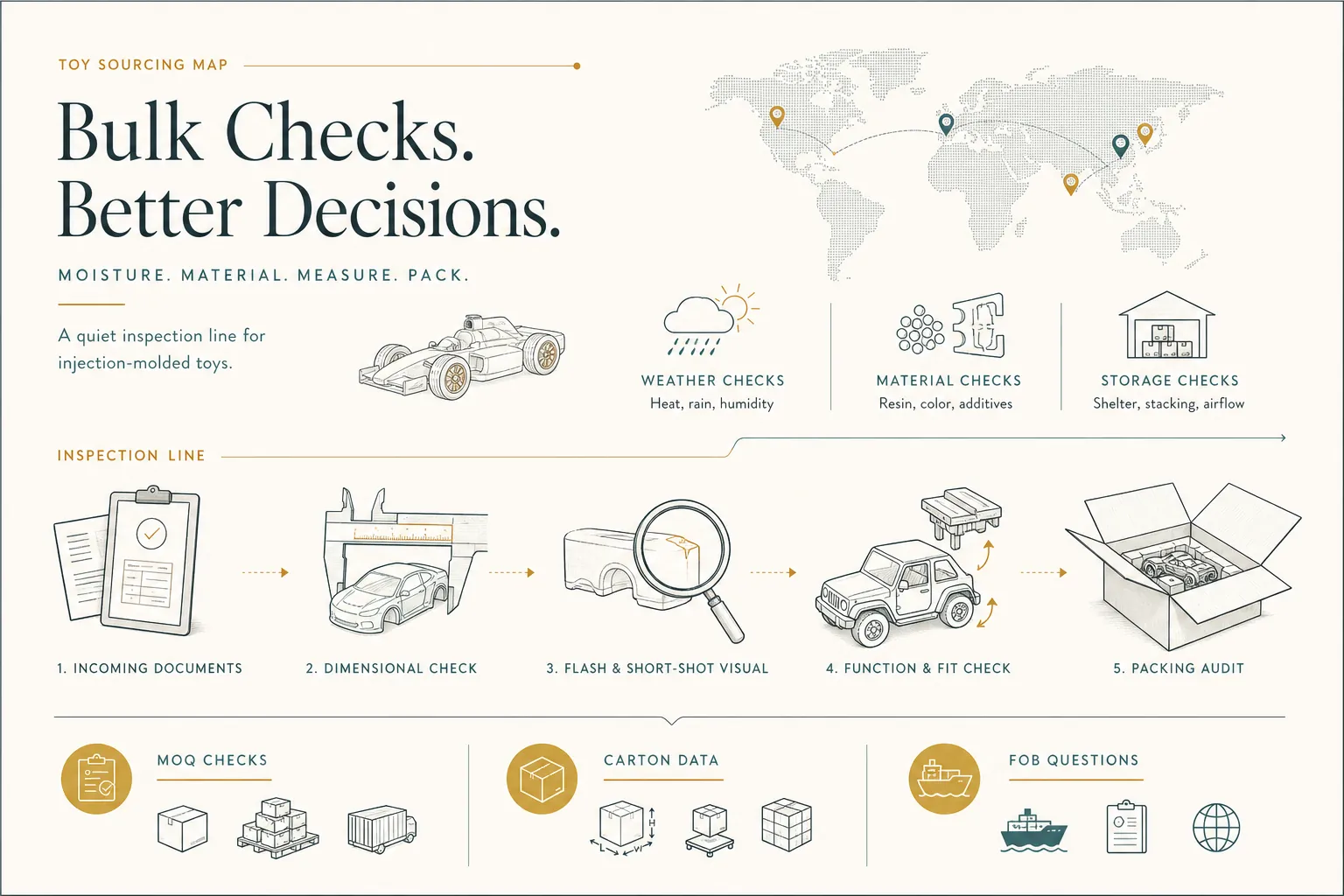
Document product fit, packaging and trade terms before you ask for a price. A useful RFQ states destination market, age grade, materials and colors, packaging language, requested tests, sample policy, tooling terms and the requested trade term. This sourcing map gives you a step-by-step framework to evaluate weather, material and storage checks, build a container-fill plan, and prepare a comparable RFQ for outdoor toys. Skip the generic best-list claims; your buying decision should rest on documented evidence, not a supplier's promise.
Key Takeaways for Bulk Outdoor Toy Buyers
- MOQ varies by SKU, so plan assortment mix: MOQs in outdoor toy catalogs range widely: some items start at 16 units, others require 360. Build your order around a mix that fills your container, not around a single hero item.
- Carton data drives container fill and protects product: Request carton dimensions, units per carton, weight and CBM per SKU. Corner-sensitive goods need written packing specs: double-wall cartons, corner boards, ECT rating, pallet height.
- FOB without a named place invites disputes: Always specify the Incoterms version and the actual named place, e.g., FOB Shantou or FOB Shenzhen. A vague FOB quote can trigger freight arguments that outlast production.
- Incoterms do not certify compliance: FOB, CIF, DDP and other Incoterms allocate trade responsibilities but do not replace CE, CPC, UKCA or other market evidence. Request compliance documents separately.
- Tooling policy is a document, not a handshake: For custom molds, get in writing the tooling fee, ownership, storage period and what happens if the tool sits idle. A verbal agreement is not a policy.
Why Buy Outdoor Toys in Bulk?
Bulk buying makes sense when your channel can turn inventory within a season. Outdoor toys are seasonal by nature, so a 40HQ container of water guns ordered in June may sit in a warehouse until next summer. The economic case for bulk rests on assortment economics: you need high-turnover items to fill CBM alongside hero products, not just a low unit price.
A mixed-container importer, for example, needed high-turnover filler to complete the cubic meters alongside outdoor goods for his 20GP and 40HQ loads. The filler had to tell a coherent story to his retail customers, not just fill space. Your assortment plan should do the same: each SKU earns its slot by margin, turnover or seasonality fit.
Bulk orders also command better per-unit pricing, but only if you can commit to the MOQ and storage. Before you negotiate price, confirm your own warehouse constraints: an inflatable item deflated stores differently from a rigid basketball hoop, and UV-sensitive plastics may degrade if stored outdoors. Document these constraints before you compare quotes.
What MOQ Should You Expect for Outdoor Toys?
MOQs vary by product category and supplier. In our catalog, outdoor toys range from a low of 16 units for a remote-control airplane to 360 units for a walkie-talkie set. Light, fast-moving items like bubble guns may have a MOQ of 24 or 180, while a hover soccer ball starts at 48. These numbers are typical for factory-direct orders, but they are not universal.
Your RFQ should ask for the MOQ per SKU, not a blanket number. A supplier may quote a lower MOQ for a standard catalog item and a higher one for a customized version with your branding. Ask: "What is the MOQ per SKU, and does it change with custom packaging, colors or branding?"
If your order volume is below the MOQ, ask whether the supplier can combine multiple SKUs to reach the total. Some factories accept mixed MOQs, but this is not guaranteed; confirm it in writing before you plan your container.
Which Weather, Material and Storage Checks Matter?
Outdoor toys face sun, water, sand and temperature swings. The material spec tells you what to expect. ABS and TPR plastics resist impact and some UV exposure, but 'plastic' on a spec sheet is vague; ask for the exact resin grade and any UV-stabilizer additives. A water gun made of thin plastic may crack in cold weather or fade in strong sun.
Storage checks are as important as weather resistance. Paper-based cartons lose strength when exposed to moisture, so container humidity and warehouse conditions matter. Carton compression or stacking checks help verify that lower cartons will not crush and damage toy packaging during pallet and container storage. For corner-sensitive goods like LCD tablets or electronics, write the packing spec into the PO: double-wall cartons, corner boards, ECT rating, pallet height.
For inflatables or UV-sensitive items, ask the supplier for the recommended storage method and maximum shelf life before degradation. Some materials become brittle after prolonged sun exposure; if your warehouse stores goods outdoors, filter those SKUs out early.
How to Build a Container-Fill Plan with Carton Data
Container fill is about CBM, not just unit count. Request from each supplier: carton dimensions, units per carton, carton weight, and CBM per carton. A 20GP container holds roughly 33 CBM, a 40HQ about 76 CBM, but verify these figures with your freight forwarder; actual usable volume depends on palletization and loading method.
Worked example (illustrative, not a real shipment): You plan a 40HQ mixed container for a resort store. You order 120 electric water guns (MOQ 120, carton data: 0.05 CBM per carton, 12 units per carton) and 144 walkie-talkies (MOQ 144, 0.08 CBM per carton, 24 per carton). That's 10 cartons of water guns (0.5 CBM) and 6 cartons of walkie-talkies (0.48 CBM). You have ~75 CBM left; you add bubble guns, hover balls and a basketball hoop to fill the cube. Without asking for carton data upfront, you'd likely misjudge the fill and pay for unused space or face a short shipment.
Use a simple spreadsheet: per SKU, list MOQ, carton dimensions, units per carton, CBM per carton, and total CBM at MOQ. Sum the CBM to see if you hit your target fill. If you're short, identify high-turnover filler items that match your retail story—not just any cheap product.
What Should You Ask Suppliers Before Comparing Quotes?
A comparable RFQ is the key to a fair price comparison. Without standard questions, suppliers quote on different assumptions and you can't compare apples to apples. Ask each supplier the same set of questions and require written answers, not verbal assurances.
Start with the product fit: "What is the exact material composition and resin grade? What weather and storage conditions is this product rated for?" Then move to packaging: "What are the carton dimensions, units per carton, carton weight and CBM?" Finally, cover trade terms: "What is the exact Incoterms version and named place—Shantou or Shenzhen—for your FOB quote?"
For custom tooling, ask: "What is the tooling fee, who owns the tool after payment, how long do you store it, and what happens if the tool sits idle for 12+ months? Please provide this in writing." Without a written tooling policy, you risk paying for a mold you don't own or losing it after a production pause.
How to Vet Supplier Evidence and Avoid Red Flags
Supplier evidence is documentation, not promises. Require a product specification sheet with material composition, packaging spec (carton, inner box), and any existing test reports. Do not assume test reports exist; ask for them. A supplier that can't produce a spec sheet for a catalog item is a red flag.
For children's products, compliance documents matter. Incoterms do not certify the toy; FOB, CIF, DDP and other trade terms do not replace CE, CPC, UKCA or other market evidence. Require the CPC matched to the specific SKU you order, not to the factory door. Tracking labels must include manufacturer, date and lot on the product or pack as required. A pretty barcode without tracking content is not compliance.
Inspection plans are another red-flag zone. Do not accept a supplier's vague 'we do quality control' as assurance. You should specify the inspection plan on the PO, including defect-class recording and lot-isolation procedure for failed lots. Buyers who want an AQL number get it from the agreed inspection plan, not from a catalogue sentence.
Supplier Evaluation Checklist
| MOQ per SKU | Varies by spec; ask for each SKU, confirm whether mixed MOQs are allowed. |
|---|---|
| Carton data | Request dimensions, units per carton, weight, CBM; verify packing spec for corner-sensitive items. |
| FOB terms | Must specify Incoterms version and named place (e.g., FOB Shantou or Shenzhen). |
| Compliance documents | Incoterms do not certify; require CE, CPC, UKCA as applicable, matched to SKU. |
| Tooling policy | Written fee, ownership, storage period, idle-tool disposition. |
| Inspection plan | Specify on PO; require defect-class recording and lot-isolation procedure. |
How to Draft Your RFQ and Purchase Plan
Your RFQ should be a single document that covers product specs, MOQ, carton data, FOB terms, tooling policy, inspection plan, labeling spec and delivery timeline. Include a 'supplier evidence' section where suppliers must attach documents, not just claim compliance. Send the same RFQ to at least three suppliers for comparable quotes.
The purchase plan pulls the RFQ answers into a decision: which SKUs to order, at what quantities, to fill your container, with a target margin. For each SKU, record the price, MOQ, CBM, and estimated landed cost (including freight and duties). Use the plan to negotiate: if one supplier's carton data shows a larger CBM per unit, your container fill changes and so does your landed cost per piece.
Before you send the RFQ, complete your internal checkpoints: per-SKU weather/material/storage fit documented, container-fill plan with CBM math, supplier document checklist, inspection clause written. A prepared buyer gets better quotes and fewer surprises.
FAQ: Bulk Outdoor Toy Sourcing Questions
What MOQ should I expect for custom orders?
MOQs vary by product and customization. Catalog items may start as low as 16 units, while custom branding or packaging can raise the MOQ. Ask the supplier for the MOQ per SKU and whether mixed SKUs can be combined to reach a container fill.
Why does carton data matter for my order?
Carton dimensions, units per carton and CBM determine how many units fit in a container and whether your product arrives undamaged. Corner-sensitive goods need packing specs like double-wall cartons and corner boards; without them, you risk crushing and damage.
Is FOB Shantou different from FOB Shenzhen?
Yes. FOB without a named place is a common source of freight disputes. Specify the exact Incoterms version and the named port or city as actually booked, e.g., FOB Shantou or FOB Shenzhen, on your PO.
Do Incoterms replace safety certifications?
No. FOB, CIF, DDP and other Incoterms allocate trade responsibilities but do not certify the toy or replace CE, CPC, UKCA or other market evidence. You must request compliance documents separately, matched to the specific SKU.
How do I handle tooling ownership and storage?
Get a written tooling policy that states the fee, ownership, storage period and what happens if the tool sits idle. Without it, you may pay for a mold you don't own or lose it after a pause in production.
What should I look for in an inspection plan?
Specify the inspection plan on the PO, including defect-class recording and lot-isolation procedure. Do not rely on a supplier's generic quality claim; an AQL number should come from the agreed inspection plan, not a catalogue sentence.
Sources
Related Products & Categories
Ready to Build Your RFQ?
Use this framework to prepare a comparable RFQ and purchase plan. For a starting point, explore our outdoor toy catalog with transparent MOQs and carton data to fill your container. Request a quote when you're ready to compare suppliers.