
Use the Misco Sports MT2287 case to check screw retention and shuttlecock battery access on comparable samples, and hold approval when either concern remains unresolved. For buyers selecting outdoor toys for toddlers, this is a mechanism-specific review—not evidence that the recalled set is toddler-suitable. Compare the first sample with the agreed written specification and design requirements; document observable discrepancies, refer safety conclusions to qualified testing, and retain an approved production reference only after approval. Keep any actual recalled MT2287 set out of play.
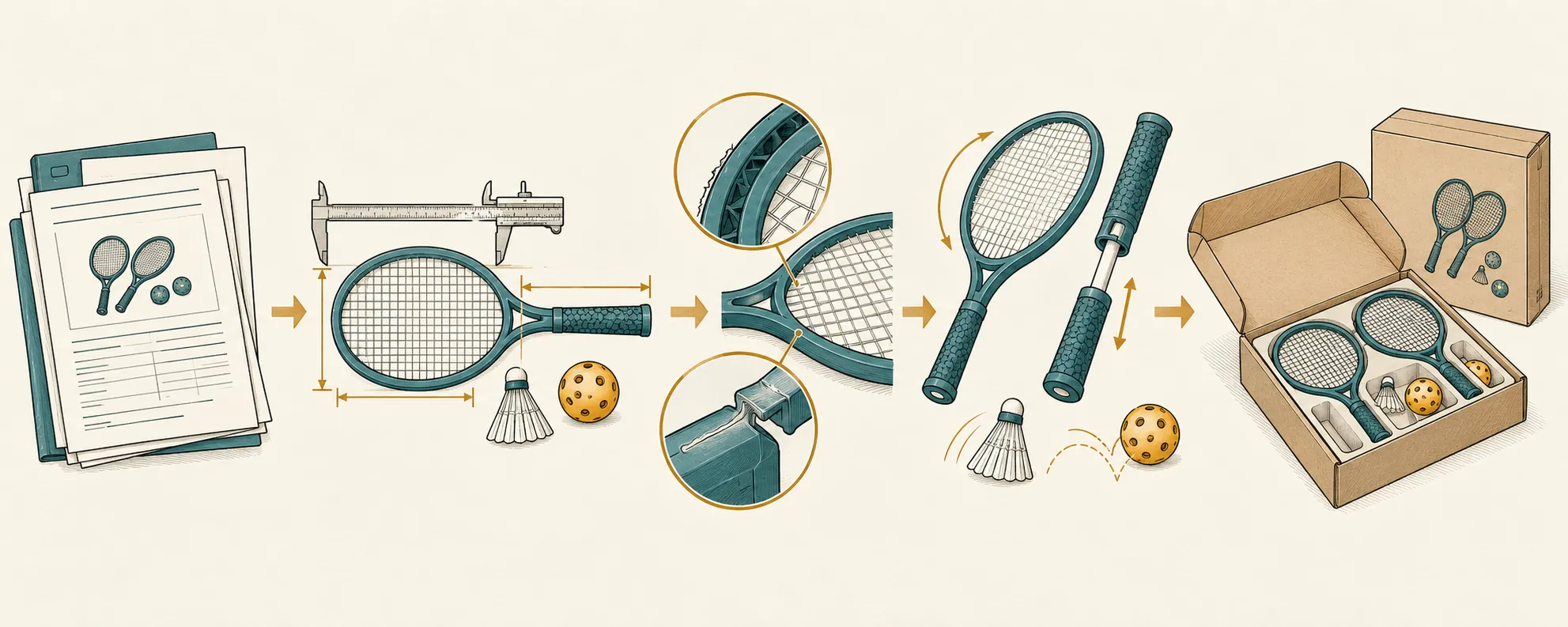
What exactly did the MT2287 recall establish?
The May 28, 2026 US recall identified two distinct failures in Misco Sports Light-Up Racket Sets, model MT2287: the racket battery-compartment screw did not remain attached when opened, and children could easily access the shuttlecock’s button cell batteries. Outdoor Toy attributed the named product’s mandatory toy-standard violation to those conditions in recall 26-514. This is a historical external case, not a finding about other outdoor toys. Outdoor Toy recall 26-514
The recalled configuration contains two black rackets, one ball and one shuttlecock. “MT2287” and “100125” appear in white on the racket handle. Check those identification details before deciding whether an item is the recalled product or merely a different product with a comparable mechanism.
Swallowed button cell or coin batteries can cause serious injuries, including internal chemical burns, and death. That ingestion consequence is why a working light is not enough to support sample approval. Illinois public health notice
If the item matches the recalled set, do not use this brief as a route to approving it. Outdoor Toy directs consumers to stop using the set immediately, take the shuttlecock away from children and contact Missry Associates for a full refund. Follow the official recall instructions rather than conducting a play demonstration. Outdoor Toy recall instructions
What should the first sample be compared with?
| Identity and supplied components | Match the model, sample revision and contents to the submission record and agreed component list. Identify every powered component, including accessories. A different closure, accessory or unidentified revision calls for reconciliation before the review proceeds. |
|---|---|
| Racket screw retention | For a comparable serviceable compartment, have an adult reviewer follow the opening instructions with the specified tool in a controlled area away from children. Record whether the screw remains attached and whether the cover closes as designed. A screw that separates where the design specifies retention is a discrepancy: hold approval and request a corrected construction. |
| Shuttlecock battery enclosure | Compare the enclosure and any intended opening method with the design drawing and instructions. Record an already open cover, loose enclosure, exposed cell or access during instructed handling. Stop handling if cells become exposed; isolate the sample and refer the concern for technical assessment. Do not force a sealed module open to imitate a compliance test. |
| Light-up and play functions | Operate each function specified for the submitted design, with the battery and assembly configuration recorded. Note intermittent operation, movement of the cover or loosening during instructed use. A functioning light does not resolve a battery-access concern; a functional mismatch requires correction and recheck. |
| Materials and finish | Compare declared component materials with the agreed material list, then inspect for visible cracks, burrs, damaged joints, exposed edges and finish differences. Record the exact location of each concern. Visual appearance and touch cannot authenticate a material grade or chemical composition; refer those questions to documentary review or qualified testing. |
| Dimensions and fit | Measure the dimensions specified on the agreed drawing, such as assembled racket length, head width and compartment-cover fit. Record the target, agreed tolerance and measured result together. An out-of-tolerance measurement or a cover that does not seat correctly requires disposition before approval; do not invent a universal tolerance. |
| Agreed retail packaging | Check the supplied contents, component restraint, model identification, instructions and artwork against the approved packaging requirements. Look for loose accessories and inconsistencies between the instructions and actual opening method. Correct packaging discrepancies separately; packaging agreement does not establish enclosure safety. |
Which sample questions require qualified testing?
Battery accessibility under the applicable test conditions and conformity with the relevant toy requirements require qualified assessment, not a buyer’s hand check.
Request a laboratory assessment for the intended market and the exact submitted construction. Ask the laboratory to identify the applicable standard and edition, required conditioning and use-and-abuse procedures, battery-accessibility method, and acceptance criteria. The request should identify the racket closure and shuttlecock enclosure separately so neither disappears inside a general “light-up function” review.
For any existing report, reconcile the tested model, component construction, battery type and closure design with the submitted sample. A different internal model code alone does not automatically require a new test, but a changed enclosure or fastening arrangement needs a technical coverage review. Keep US and EU assessments and destination-specific documents separate.
Do not substitute pliers, an improvised pull test or an arbitrary number of opening cycles for the specified laboratory method. A clean screening observation cannot certify safety or determine a suitable age range.
What should the sample review record contain?
| Sample identity and revision | Enter the product/model, supplier submission reference, sample revision, receipt date and identifiers of the physical units examined. |
|---|---|
| Specified target and source record | Cite the agreed specification, drawing, material list, instructions and packaging revision used for each check. Record the required condition or dimension beside its source. |
| Actual observation | Record what happened on the identified component, the opening or operating method used, and any measurements. Attach photographs where useful; a missing photograph alone does not invalidate otherwise identifiable observations. |
| Component presence or absence | Record separately whether the sample has a racket battery compartment, a shuttlecock battery enclosure and button or coin cells. Support an absence or not-applicable entry with physical inspection and the component list; do not treat catalog silence as confirmed absence. |
| Qualified-testing assessment | Identify the applicable report or laboratory request, the construction it covers, the responsible technical reviewer and any required follow-up. |
| Discrepancy and proposed correction | Link each discrepancy to its target and observation. Record the supplier’s proposed correction, responsible owner and agreed completion date. |
| Decision and authorization | Select hold, request evidence, request qualified testing or approve. State any conditions, the authorized approver’s name and the decision date. |
| Closure and production-reference release | Record the corrected revision, reinspection result, testing review where required, closure approver and closure date. After approval, identify and retain the approved production reference with its governing documents. |
Which components are outside the water-and-sand examples?
The beach trolley toy and rotating fishing-game sand-and-water table descriptions do not identify the two MT2287 components: a racket battery compartment and a button-cell-powered shuttlecock. They should not be described as affected by this recall or as sharing its mechanism.
The beach trolley is cataloged as a plastic water-and-beach play item with card packaging. The fishing-game table is cataloged as a plastic item with a rotating board, music switch and color box. A music switch does not establish battery chemistry, enclosure construction or accessibility. Confirm the actual configuration and record other powered modules separately.
Within racket/badminton, target/blaster and outdoor ride-on reviews, transfer these questions only where the submitted construction contains a comparable battery enclosure or retention feature. A category name alone is not a mechanism match. Do not extend this case into electrical or pinch-hazard claims about unrelated water and sand toys.
What happens after a discrepancy is found?
Hold the affected approval decision until the discrepancy has a documented disposition, then review the corrected sample against the same agreed requirements and any authorized design changes.
For example, if a comparable sample’s screw separates despite a drawing requiring it to remain attached, record that observation as a design mismatch. Request the correction, identify the revised closure and have the technical reviewer determine the testing needed. A replacement screw that looks similar is not, by itself, closure of the issue.
Bulk comparison comes next: inspect production against the written specification, approved production reference, authorized change records and applicable inspection plan. The retained sample complements those records; it is not the only valid basis for inspection. Together they support traceability, but they do not by themselves prevent or reveal an undisclosed change.