
The mistake that costs outdoor toy buyers the most is approving a supplier on photos and a catalog page, then discovering the plastic warps, the packaging crumbles in a humid container, or the color drifts from the sample. A component review — checking weather resistance, material choice, storage behavior, and the packaging spec on paper — is the step that separates a one-off loss from a repeatable line. This guide walks you through the concrete checks and the exact questions to put to any supplier before you commit to a wholesale order.
Key Takeaways
- Physical golden samples settle disputes; a photo approval will cost you on the second lot. Compare bulk production to the sealed physical piece for color, fit, flash, and function.
- Packaging specs belong in the booking file, not in a verbal promise. Double-wall cartons, corner boards, ECT rating, and pallet height must be written into the shipping instruction.
- Never accept an AQL number from a catalog sentence. The inspection plan with defect classes and acceptance limits is agreed on the PO, and that document is what you request.
- Warpage in plastic parts should be measured on the assembled toy, not on a flat loose part — uneven cooling, shrinkage, or orientation shows up only in the full assembly.
- An absence of a recall in the Outdoor Toy database is not a safety certification. Search it by product, brand, and hazard, then still request the supplier's compliance evidence.
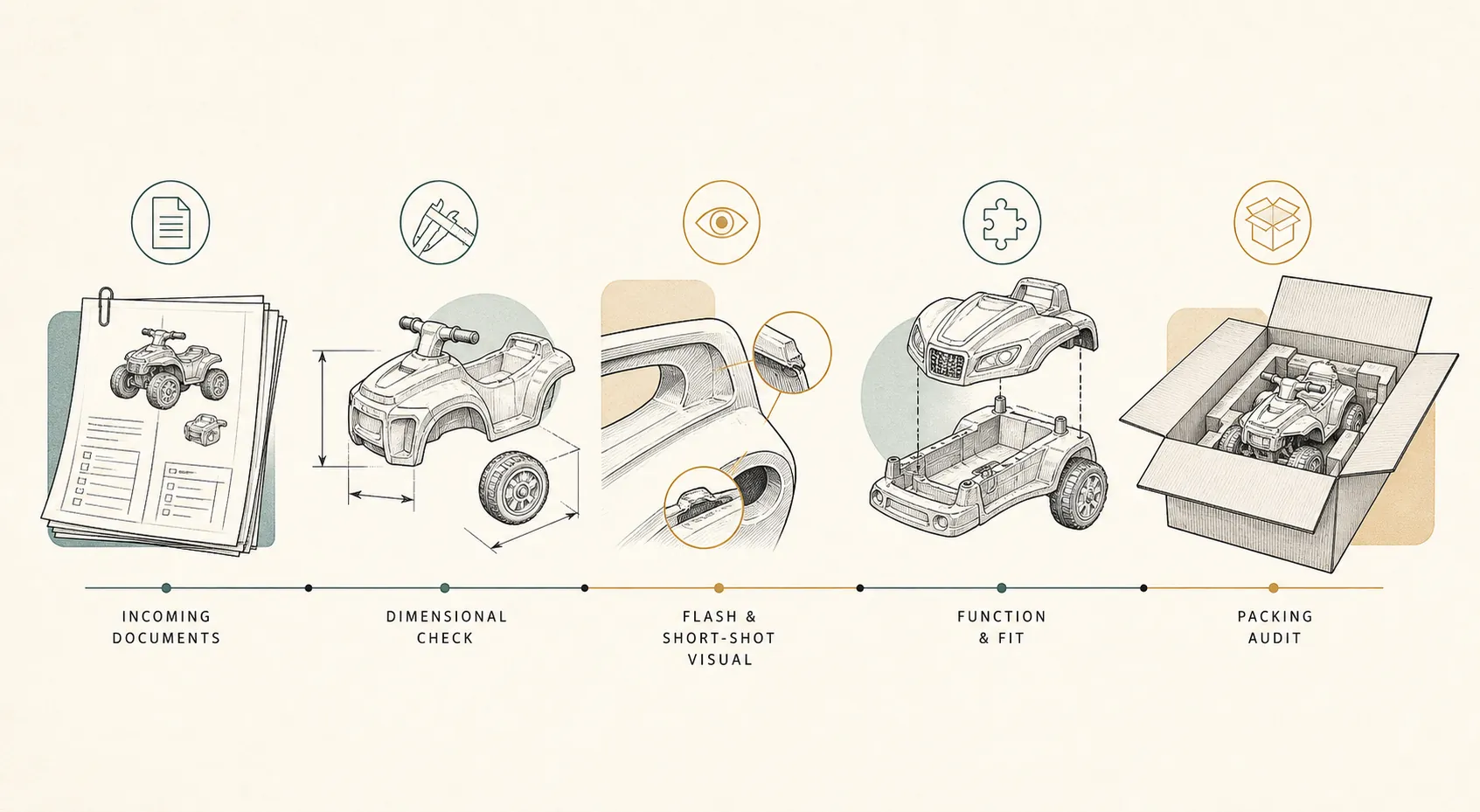
Component Review Checklist: What to Verify vs. What to Ask
| Golden sample | Supplier sends a sealed physical sample; bulk production is compared to that piece, not to photos. Ask: 'Will bulk be matched against the sealed golden sample for color, fit, and function?' |
|---|---|
| Material spec | Supplier provides the polymer grade (e.g., HDPE vs. LDPE vs. HIPS) and any UV/water-resistance data. Ask: 'Which of your outdoor SKUs use UV-stable or water-safe plastics? Share the product records.' |
| Packaging / LCL protection | Booking file states double-wall cartons, corner boards, ECT rating, and pallet height. Ask: 'What exactly is written in your booking instruction for LCL shipments?' |
| Inspection plan | PO defines the AQL, inspection level, and defect classes. Ask: 'What is the agreed AQL and defect-class protocol in the PO inspection plan? Can I see the document?' |
| Storage / display | Supplier explains how products hold up in retail display and storage conditions. Ask: 'Do you have a buyer reference where outdoor toys performed well in display or reduced counter returns?' |
How to Run the Component Review: Six Checks That Matter
The first check is the physical sample. Ask for a sealed golden sample of each outdoor SKU you are considering — water blasters, sand toys, sports items. The argument that ends a color fight is the physical piece on the QC shelf, not an email thread. Compare bulk to that sample for color, fit, flash, and function. Buyers who approve only a photo pay for it on the second lot.
Next, verify the packaging spec on paper. For LCL shipments, corner-sensitive goods die when the booking instruction is a thank-you note. The booking file must state double-wall cartons, corner boards, ECT rating, and pallet height. Claims are won on the booking file — so request that document, not a verbal assurance.
Then, confirm the defect protocol. Do not accept a catalogue AQL number. On the factory floor, a failed lot is isolated, the defect class is recorded, and the lot is released only after rework. The number you need comes from the agreed inspection plan on the PO — so ask to see that plan before you order.
Review the product records for weather and material fit. Look at the supplier's existing outdoor lines and check the material spec: is it a rigid HDPE for molded parts, a flexible LDPE for squeezable components, or a toughened HIPS for rigid parts? Ask which SKUs use UV-stable or water-safe plastics, and request the product records.
Assess storage and display behavior. Warpage, for example, can result from uneven cooling, shrinkage, or orientation — and it should be measured on the assembled toy, not on a flat loose part. Ask the supplier how the product performs in retail display conditions, such as a squeeze-test zone or outdoor shelving, and whether they have a buyer reference for counter-return performance.
Finally, check the supplier's client base for relevance. Supplier qualification should evaluate capability, material control, quality records, compliance evidence, capacity claims, and subcontracting — not a catalog page. Confirm the supplier works with mass-market and specialty retailers that distribute outdoor toys in wholesale channels.
What About Compliance and Recalls?
Run the Outdoor Toy recall database search yourself. It records market actions and should be searched by product, brand, and hazard. An absence of a recall is not a safety certification — it is just the absence of a recall. For toys sold in the US, ASTM F963 and Outdoor Toy are the relevant frameworks; for the EU, it is the Toy Safety Directive and EN 71. Your supplier should provide compliance evidence per destination market, and that evidence goes into the PO file, not a verbal claim.
Worked Example: A Sample Outdoor Toy Shipment (Illustrative, Not a Real Order)
Imagine a buyer shortlists two suppliers for a water blaster line. They request a sealed golden sample from each. Supplier A sends the sample with a photo; Supplier B sends the sample and confirms bulk will be matched to the physical piece. The buyer checks the booking file: Supplier A's file mentions only 'standard export cartons'; Supplier B's file specifies double-wall, corner boards, ECT 32, and pallet height. The PO inspection plan from Supplier B defines the AQL and defect classes; Supplier A points to a catalog sentence. The buyer chooses Supplier B — not because the price is lower, but because the component review evidence is complete. The shipment arrives with no corner damage and the color matches the golden sample. This is an illustrative scenario, not a real shipment.
FAQ
What is the minimum order quantity for a custom outdoor toy?
MOQ varies by SKU and by supplier. For example, some outdoor toys carry an MOQ as low as 36 units, while others require 480. Confirm the MOQ for the specific SKU and whether it applies per color or per design.
What should I check in a component review for outdoor toys?
Check the physical golden sample against bulk, the material spec (polymer grade, UV/water resistance), the packaging and LCL protection written into the booking file, the PO inspection plan (AQL, defect classes), and storage/display behavior.
Is a photo of the sample enough to approve production?
No. A photo approval leads to color and fit disputes on the second lot. The sealed golden sample on the QC shelf is the reference; bulk production should be compared to that physical piece for color, fit, flash, and function.
Where should the AQL number come from?
From the agreed inspection plan on the PO, not from a catalog sentence. The plan defines the AQL, inspection level, and defect classes. Ask the supplier to show you the plan document before you order.
What packaging details should be in the booking file for LCL?
Double-wall cartons, corner boards, ECT rating, and pallet height. These specs belong in the written booking instruction; claims are won on the booking file, not on verbal assurance.
Does an absence of a recall mean the toy is safe?
No. The Outdoor Toy recall database records market actions; searching it by product, brand, and hazard is a due-diligence step, but an absence of a recall is not a safety certification. Request the supplier's compliance evidence for your destination market.
Sources
Related Products & Categories
Request a Custom Quote
Ready to run the component review on your shortlist? Send your target SKUs and destination markets, and ask for the physical golden samples plus the PO inspection plan before you commit.