
The sealed golden sample on the QC shelf, plus a written booking file, settles the weather, material, and storage debate for outdoor toys. A glossy product photo or a Canton Fair booth shot cannot tell you how a bubble gun, water blaster, or stepping stone will survive a summer in the sun and a month in a container. Fair lighting lies, and a booth sample is often a hand-picked hero unit. This guide walks wholesale buyers through three concrete checks — weather, material, and storage — and gives you the exact questions to ask each supplier before you commit a PO.
Work through these checks with the samples you have in hand, record deviations by defect class, and defer any AQL number to the inspection plan written on your PO. That is the repeatable way to decide whether a sample fits your outdoor-use program.
Key Takeaways for Outdoor Toy Buyers
- Weather check is a question, not a guess: Never assume a toy's UV or temperature tolerance. Ask the supplier for the intended outdoor exposure envelope (sun, rain, temperature range) and match the physical sample against that stated condition. No IP rating or UV number exists in the product record unless the supplier states it in writing.
- Material check means the golden sample, in your hand: Compare bulk or pre-production parts against the sealed golden sample — colour, fit, flash, function — using the same resin grade, surface finish, and lighting. A photo approval is a second-lot gamble.
- Storage check wins claims on the booking file: Corner-sensitive goods like LCD toys die in LCL when the booking instruction is vague. Double-wall cartons, corner boards, ECT rating, and pallet height must be written into the booking file — that is what wins a damage claim.
- AQL is a PO term, not a catalogue sentence: Do not accept an AQL number from a blog or a sales pitch. The acceptable quality level and defect classes (critical/major/minor) belong in the agreed inspection plan referenced on the PO.
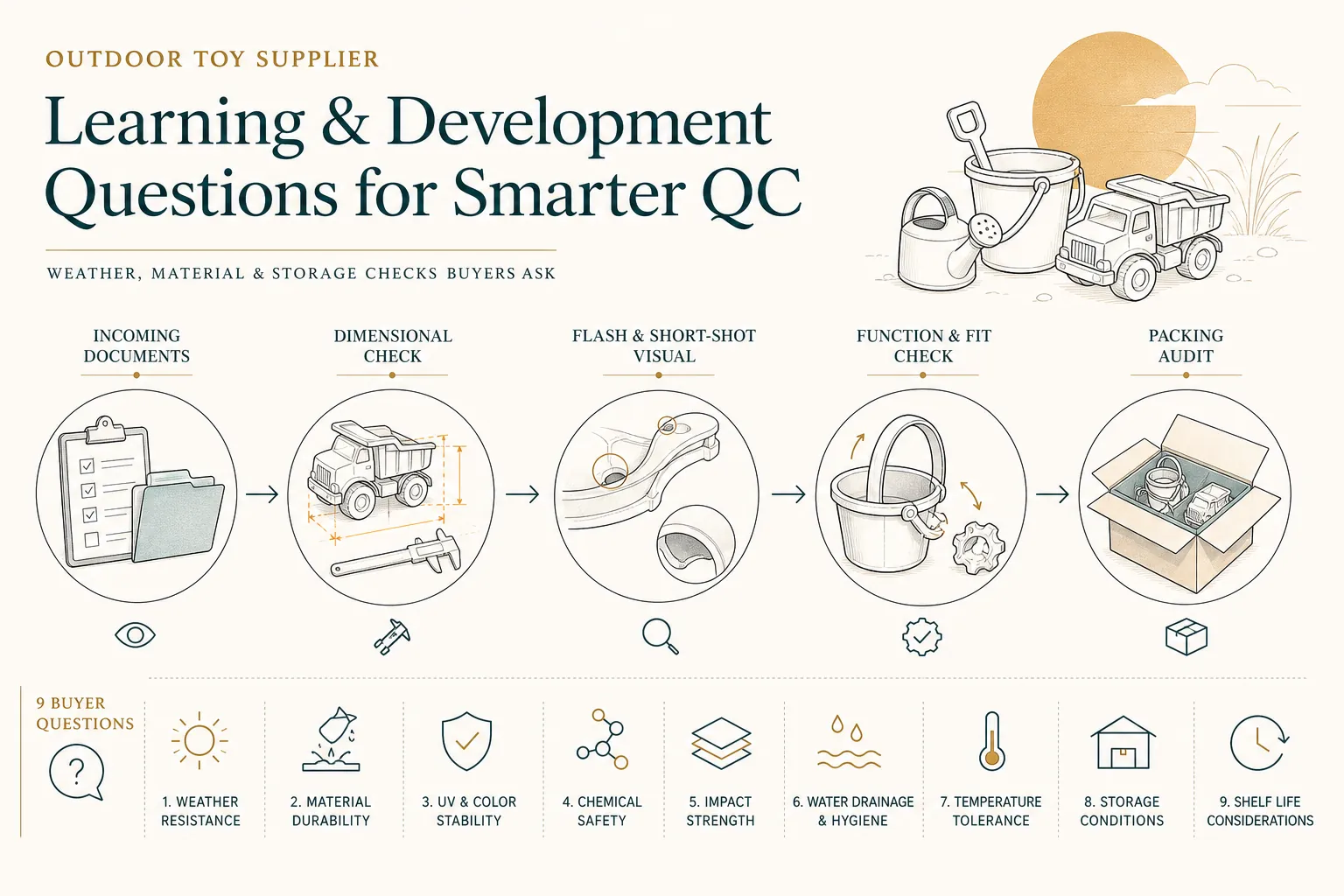
What weather questions should I ask an outdoor toy supplier?
Ask the supplier for the maximum continuous UV exposure, the operating temperature range, and the humidity or moisture limits for the material. Rain, temperature cycling, sand, and dirt affect outdoor toy joints, labels, batteries, and coatings in addition to the plastic body — that is a known risk category for plastic toys. So the first supplier question is not 'is it waterproof?' but 'what conditions is this SKU designed for?'
If the supplier cannot state a number for UV, temperature, or humidity, that is a red flag. Record their answer next to the sample, then inspect the physical piece for signs that match — faded colour, brittle plastic, or swollen labels are visual cues that the stated envelope is marketing.
Keep the question specific to the SKU. A water gun's exposure is different from a soccer goal's. A plastic bubble gun might sit in a hot warehouse, while a cloth golf set faces sand and abrasion. The supplier's answer should align with the product record, not a generic 'outdoor safe' claim.
How do I verify material quality against the golden sample?
Compare bulk parts against the sealed golden sample on four points: colour, fit, flash (excess plastic on mould lines), and function. For eleven years in Chenghai, the argument that settles a dispute in the factory is that physical piece on the QC shelf — not an email, not a photo. This is the production-part approval step: the first released parts should be compared with the signed drawing, the golden sample, and the applicable safety test sample.
Colour matching has a specific rule: you must use the same resin grade, surface finish, lighting condition, and approved master sample, because appearance changes with all four variables. A slightly different resin batch can shift the colour under sunlight, which matters for outdoor toys that sit in bright displays.
Label the sample with its tool number and revision. If the supplier brings a fresh sample to a trade fair, do not treat it as the production standard. The revision card on the table tells the truth; the fair lighting does not. Buyers who approve only a photo pay for it on the second lot — so keep the physical comparison as the gate.
What storage and packaging checks protect my container load?
Write the packaging spec into the booking file: double-wall cartons, corner boards, ECT (edge crush test) rating, and pallet height. LCD tablets and other corner-sensitive goods die in LCL when the booking instruction is a thank-you note. The buyer who wins a damage claim has the specs written down, not a verbal promise.
For outdoor toys, add a moisture question. Under what humidity or moisture conditions does the material degrade, and what storage limit applies before shipment? A container that sits at a transshipment port in the tropics can expose plastic and cloth goods to humidity that a standard carton is not designed for. The supplier's answer should be specific to the SKU's material — ABS, plastic, or cloth.
Supplier qualification should evaluate capability, material control, quality records, compliance evidence, capacity claims, and subcontracting — not just a catalog page. And supplier records for materials, production, inspection, change control, and testing should be retained long enough to support your market and recall obligations. That is a documentation check that belongs in the same review as the packaging spec.
How do I turn these checks into a sample decision?
Document each deviation you find and record the defect class — critical, major, or minor. Do not invent an AQL number; the acceptable quality level comes from the agreed inspection plan on the PO. Your job at the sample stage is to decide pass or fail based on the evidence in front of you.
A worked example (illustrative, not a real shipment): you are comparing a splatter water blaster (plastic, MOQ 200) and a stepping stones set (ABS, MOQ 60) for a resort program. The supplier states the water blaster is rated for outdoor sun exposure up to 40°C. You lay the bulk sample next to the golden sample and find the colour is a shade lighter under the same lighting — a material deviation. The stepping stones sample matches the golden sample on colour and fit, but the supplier cannot state a humidity limit for the ABS before shipment. Your decision: the water blaster fails the material check pending a colour re-match; the stepping stones fail the storage check pending a written humidity spec. Neither PO moves until the evidence is complete.
If the evidence is insufficient, escalate to the supplier questions in the next section. The decision rule is simple: no stated weather envelope, no golden-sample comparison, no written storage spec — no PO.
Outdoor Toy Sample Check: What to Verify
| Weather check | Ask for max UV exposure, temperature range, and humidity limits. Compare the physical sample to the stated envelope. Red flag: supplier cannot state a number. |
|---|---|
| Material check | Compare bulk to the sealed golden sample on colour, fit, flash, function. Use the same resin grade, surface finish, and lighting. Red flag: approval based on a photo. |
| Storage check | Confirm packaging spec in the booking file: double-wall, corner boards, ECT, pallet height. Ask for moisture degradation limits. Red flag: vague booking instruction. |
| Documentation check | Verify supplier records for materials, production, inspection, change control, and testing. Red flag: no retention policy to support recall obligations. |
What to Ask Suppliers (RFQ Checklist)
Use these five questions as the core of your RFQ or sample-evaluation email. Each one targets a gap that a catalog page will not fill.
1. What is the maximum continuous UV exposure and temperature range this product is designed for in outdoor use?
2. Which material grade and thickness is used, and how does the bulk sample compare to the sealed golden sample on colour and fit?
3. What is the packaging spec (board type, ECT rating, corner board placement, pallet height) for the container load?
4. Under what humidity or moisture conditions does the material degrade, and what storage limit applies before shipment?
5. Can you provide the inspection plan reference on the PO that defines the AQL and defect classes for this lot?
FAQ: Outdoor Toy Sample Evaluation
What is the difference between a golden sample and a pre-production sample?
The golden sample is the sealed, approved physical reference on the QC shelf. The pre-production sample is the first part released from the tool. You compare the pre-production part against the golden sample, the signed drawing, and the safety test sample — not against a photo.
Can I skip the weather check if the toy is plastic?
No. Rain, temperature cycling, sand, and dirt affect joints, labels, batteries, and coatings in addition to the plastic body. Ask the supplier for the intended exposure envelope — UV, temperature, humidity — and verify the sample against it.
Who sets the AQL for my outdoor toy order?
The AQL is a negotiated term between buyer and supplier, defined in the inspection plan on the PO. It is not a fixed number from a standard or a catalogue. ISO 2859 provides the sampling framework, but the specific AQL value is agreed per order.
How do I protect against container damage for corner-sensitive toys?
Write the packaging spec into the booking file: double-wall cartons, corner boards, ECT rating, and pallet height. A damage claim is won on the booking file, not on a verbal promise. For LCL shipments, confirm the spec matches the actual carton used.
Does paying a sample fee give me tooling ownership?
No. Injection-tool ownership, movement rights, maintenance, and storage are contractual matters and are not implied by paying a sample or development fee. Confirm tooling terms in writing before you commit to a production run.
Sources
Related Products & Categories
Ready to compare samples against a clear checklist?
Use the five supplier questions above as your RFQ template. If you are evaluating outdoor toys for a wholesale program and need a starting point for sample requests, review the product range and ask for the sealed golden sample before you commit a PO.
Explore outdoor toy options like the 69 Holes Electric Automatic Gatling Bazooka Bubble Gun Machine Outdoor Toys Bubble Maker Blower Gun or the Soccer Balls Game Outdoor Indoor Toys Set Soccer Goal Game with Light-up Sport Toys to see how the checklist applies to different SKUs.